
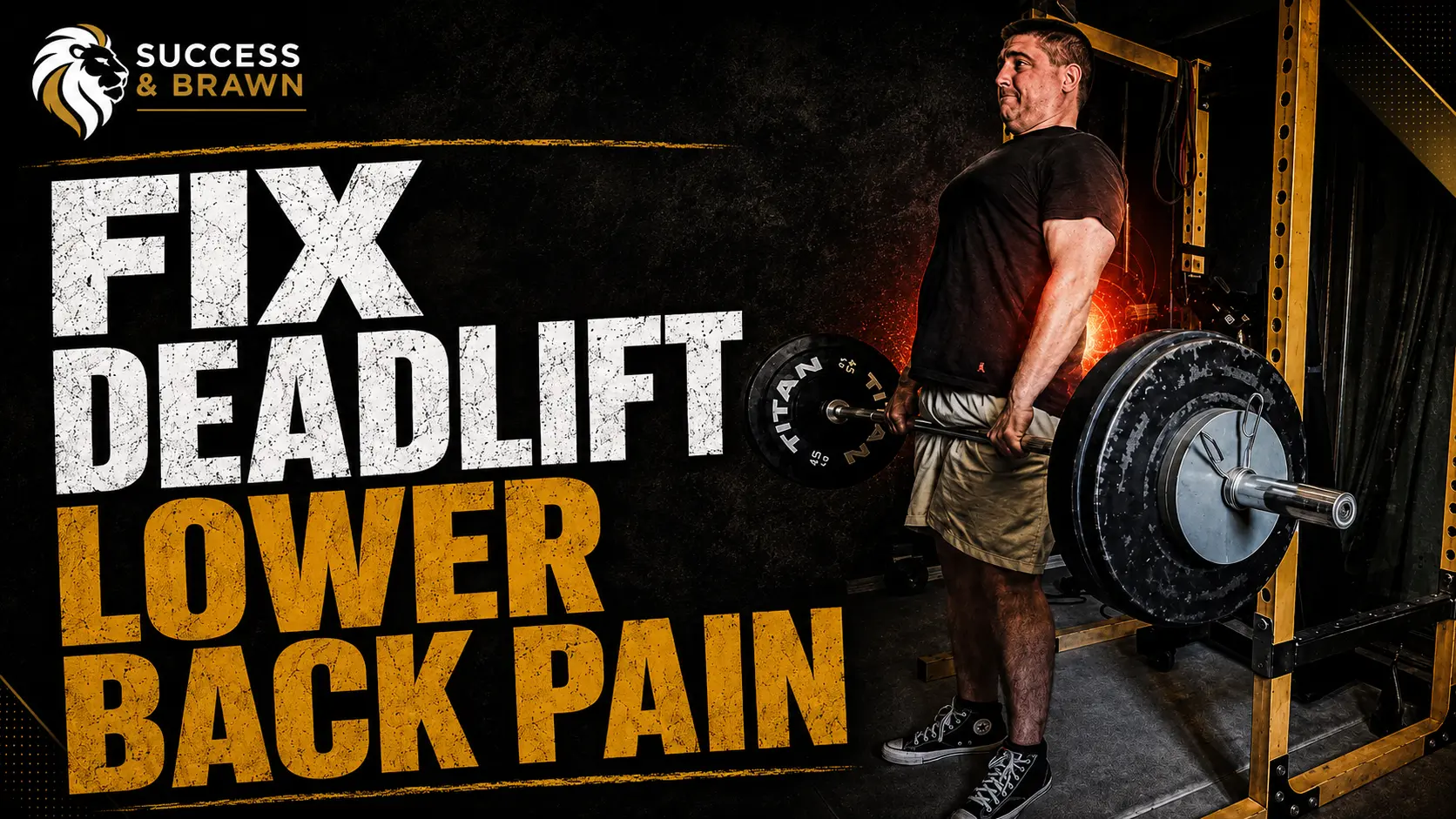
For a long time, deadlifts did not feel right for me.
I wanted to deadlift.
I love deadlifting.
I wanted my back to look like a fucking Ninja Turtle shell.
But every time I pulled from the floor, my lower back felt like it was taking over the entire movement.
Not my legs.
Not my glutes.
Not my whole body working together.
Just my lower back getting smoked.
And that is not how a deadlift should feel.
Your lower back is obviously going to be involved in a deadlift. It is a heavy hinge movement. Your back has to stay tight, braced, and strong. But the deadlift should not feel like a pure lower back exercise.
And It definitely should not cause sharp pain.
If every deadlift session leaves your lower back pumped, tight, angry, or completely wrecked, there is a good chance something is off with how you are pulling.
For me, the problem was simple:
I was not using enough legs.
The Cue That Messed Me Up
A popular deadlift cue you will hear from a lot of strength coaches is:
“Don’t drop your hips.”
You will also hear:
“Don’t move the bar.”
And to be clear, those cues are not automatically bad.
There is a reason coaches say them.
If you drop your hips too low, the deadlift can turn into a weird squat. Your knees can shove forward, the bar can drift away from you, and then your hips shoot up anyway before the bar leaves the floor.
So the cue makes sense.
The problem was not necessarily the cue.
The problem was how I and a lot of other lifters interpret it.
For some reason, in my head, “don’t drop your hips” turned into:
“Don’t bend your legs.”
And that completely wrecked my deadlift.
I Turned My Deadlift Into a Good Morning From the Floor
Because I was so focused on not dropping my hips, I started setting up with my legs barely involved.
My hips were high.
My knees were barely bent.
My torso was folded way over the bar.
Then I would try to pull the weight off the floor almost entirely with my back.
That is not a deadlift.
That is a good morning from the floor.
And when you turn your deadlift into a good morning from the floor, it makes sense that your lower back gets destroyed.
Your legs are supposed to help break the bar off the floor. Your whole body is supposed to be involved. But I had accidentally taken my legs out of the lift.
I was trying to be technical.
I was trying to follow a good cue.
But I had taken it too far.
The Cue That Fixed My Deadlift: Get Leggy
The cue that finally helped me fix this was one I came up with for myself:
Get leggy.
That is it.
Get leggy.
Use your legs.
Bend your legs enough to get into a strong position. Hold onto the bar. Brace hard. Then think about standing up straight while driving through your legs.
Not squatting the weight up.
Not yanking with your back.
Not trying to turn the deadlift into some complicated science project.
Just get into position, hold the bar, and stand up with your legs.
That cue helped me because it got me out of my head.
Instead of obsessing over whether my hips were too low or too high, I started thinking about using my legs as the primary mover off the floor.
My back was still involved. Of course it was.
But it stopped feeling like my lower back was doing the entire lift.
The Deadlift Should Not Feel Like All Lower Back
This is the big point.
The deadlift is not supposed to feel like your lower back is the only thing working.
You should feel your legs. You should feel your glutes. You should feel your upper back staying tight. You should feel your whole body working together.
When I deadlift heavy, it feels like I just hit heavy low bar squats. The same muscle (glutes, hamstrings, quads, and my entire back) feel sore the next few days.
But if you finish every set and your first thought is, “My lower back is fried,” you may be doing what I was doing.
You may be pulling with high hips, barely bending your legs, and forcing your lower back to do work your legs should be helping with.
Again, your lower back will work during deadlifts. But it should not feel like the entire movement is just your lower back fighting for survival.
Think About How You Pick Up a Heavy Object
One thing that helped me think about this more clearly was comparing the deadlift to picking up a heavy object in real life.
If you had to pick something heavy off the ground, would you naturally keep your legs almost straight and fold over at the waist?
Probably not.
You would bend your legs.
You would get closer to the object.
You would grab it.
Then you would stand up.
That does not mean you turn the deadlift into a full squat. It just means your legs need to be part of the movement.
For me, that was the missing piece.
I was trying so hard not to “drop my hips” that I forgot to actually use my legs.
The Trap Bar Helped Me Relearn the Movement
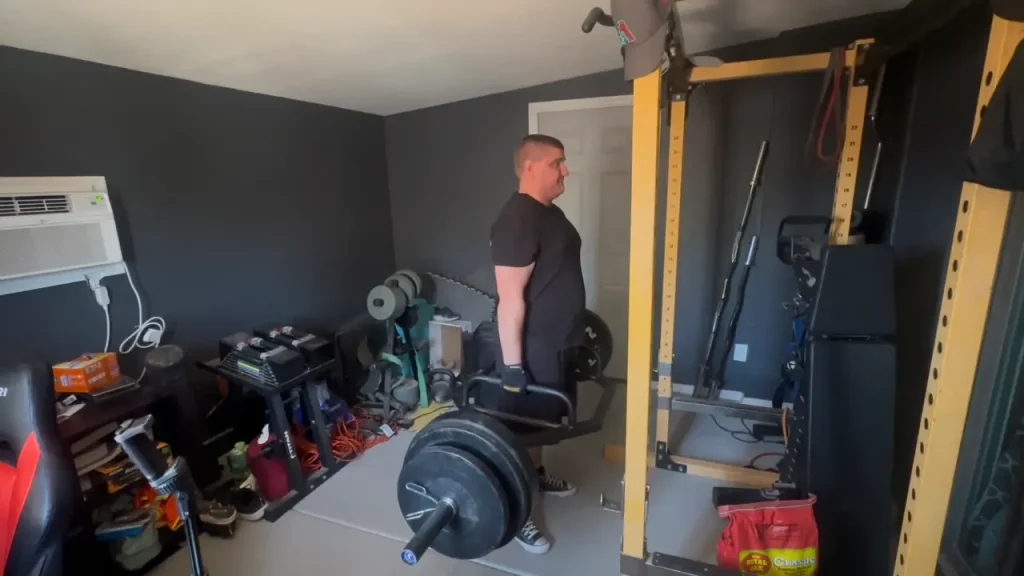
One of the best things I did was switch to the trap bar deadlift for a while.
Specifically, I used the high handles.
The high-handle trap bar deadlift helped me because the weight was centered around my body instead of sitting out in front of me like a straight bar.
That made it easier for me to feel my legs again.
I was not bent way over the bar. I was not reaching as far. I could get into a stronger position, push through my legs, and stand up with the weight.
After a while, that movement started to retrain my brain.
I started to remember what it felt like to actually use my legs in a pull.
Then, after about a month of using the high-handle trap bar deadlift, I went back to the straight bar.
And boom.
My straight bar deadlift felt 100X better.
I was using my legs again. The pull felt smoother. My lower back was no longer taking over the entire lift.
In fact, I barely felt it in my lower back at all!
Why I Like the High Handle Trap Bar Deadlift Better for This Fix
I am not saying low-handle trap bar deadlifts are bad.
They are not.
But for what I was trying to fix, the high handles worked better for me.
The low handles can feel more squatty, depending on your build and the trap bar you are using. For some people, that may be great. But I was not trying to turn the lift into a squat.
I was trying to relearn how to use my legs while still keeping the movement closer to a deadlift.
The high handles gave me the right balance.
They let me use my legs more without forcing me into a super deep starting position.
That made them a great tool for rebuilding my pull.
Short Arms Can Make This Worse
Another thing that matters is body type.
I have shorter arms for deadlifting.
A simple way to know you may have shorter arms for deadlifting is this:
When you stand up with the bar, the bar is basically right at your nuts.
That is not scientific, but it is a pretty good rule of thumb.
If you have shorter arms, the straight bar deadlift can make you feel like you are reaching way down over the bar. That can make it easier to get folded over and turn the lift into a lower back movement.
That does not mean you cannot deadlift.
It just means you may need to pay extra attention to your setup.
For me, that meant bending my legs more, using the trap bar for a while, and finding a position where my legs could actually contribute off the floor.
A Simple Way to Check Your Deadlift
Purchase a cheap smartphone tripod from Amazon and film yourself doing deadlifts from the side.
You do not need a professional analysis.
Just look at what happens when the bar leaves the floor.
Are your legs actually helping?
Or do your hips shoot up first while your torso folds over and your lower back takes over?
If your legs barely move and your back angle changes immediately, you may be doing the same thing I was doing.
You may be turning your deadlift into a good morning.
The goal is not to make every deadlift look exactly the same for every person. Different builds will have different starting positions.
But your pull should look and feel like your whole body is working.
Not just your lower back.
What I Do Now
Now I regularly use both straight bar deadlifts and high-handle trap bar deadlifts.
The straight bar lets me practice the classic deadlift.
The trap bar helps keep me in the groove and reminds me to stay leggy.
For me, the trap bar is not a “cheat” lift. It is a tool.
It helped me rebuild my deadlift, get my legs involved again, and come back to straight bar pulling without my lower back getting destroyed.
That is a win.
Final Thoughts
I am not saying this will fix every person’s deadlift.
I am not saying lower back pain is always a form issue.
And I am definitely not saying to keep pulling through sharp pain.
If you have sharp pain, stop and figure out what is going on.
But if your deadlift always feels like a lower back exercise, this is worth looking at.
You might not need to quit deadlifting.
You might not need some complicated program.
You might just need to stop taking the “don’t drop your hips” cue too literally.
Bend your legs.
Use your legs.
Hold onto the bar.
Stand up straight.
Get leggy.
That simple cue fixed my deadlift, helped me stop wrecking my lower back, and made the lift feel right again.